Patios we clean
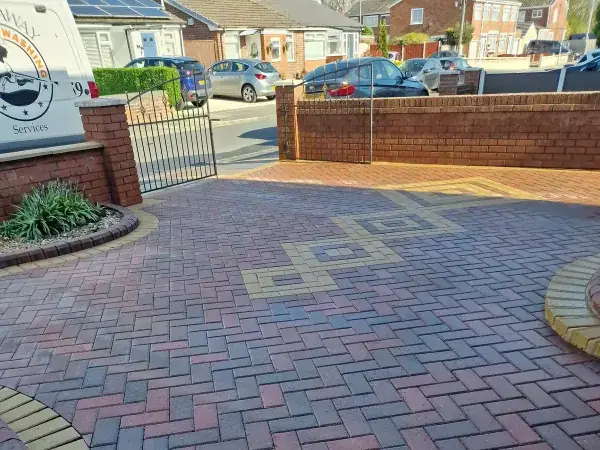
Blastaway Pressure Washing Services cleans patios across Prescot, Knowsley, St Helens and the east and south sides of Liverpool. Round here the same few surfaces come up again and again:
- Indian sandstone, riven or sawn
- Yorkstone and reclaimed flags
- Concrete flags and council-style slabs
- Porcelain paving
- Block paved patios, paths and seating areas
- Limestone and slate
A lot of gardens in this part of Merseyside got an Indian sandstone patio in the 2000s and 2010s, and by now plenty of them are carrying black spot lichen, moss in the joints and a green film that turns lethal after rain. Older semis in Whiston, Rainhill and Huyton often still have their original concrete flags, while the newer estates towards Knowsley and Widnes tend to be porcelain. Each surface needs cleaning differently, and getting that choice right is most of the job.
How we clean a patio
- Look at the stone first. Riven sandstone, smooth porcelain and 50-year-old concrete flags all behave differently under a pressure washer. We check the surface, the pointing and where the water drains before anything gets switched on.
- Clear and pre-treat. Furniture and pots moved, joints scraped out where needed, and black spot or heavy algae pre-treated with the right solution so the clean actually shifts it instead of smearing it about.
- Clean with the right method. On sound flags and block paving that means a rotary surface cleaner, which gives an even finish with none of the stripes a hand lance leaves behind. On softer sandstone, limestone or fragile pointing we drop the pressure right down or soft wash instead.
- Rinse and treat. The whole area gets rinsed off, paths and drains included, then we apply a treatment that stops moss, algae and lichen coming straight back.
- Optional sealing. On sandstone especially, a sealer brings the colour up and makes the next clean easier. We’ll tell you straight whether your patio is worth sealing, because not every surface is.
What goes wrong when it’s done badly
Patio cleaning looks simple, and that’s exactly why so many patios get ruined. Indian sandstone is softer than it looks: hit it at full power with a narrow nozzle and you’ll pit the face, open up the grain and leave lance marks that only show once the patio dries. An opened-up surface then holds water and greens over faster than it did before it was ever touched.
Pointing is the other casualty. Blast the joints on a flagged patio and the mortar comes out with the muck, slabs start rocking, and you’re into repointing money. Porcelain has its own traps: it needs hardly any pressure at all, just the correct detergent, and acid-based cleaners will dull limestone and some sandstones on contact. Anyone can hire a jet wash for the weekend. Knowing when not to use it at full power is the difference between a clean patio and a damaged one.
Why patios round here turn green so fast
This is a damp corner of the country. Mild wet winters off the Mersey, shaded north-facing yards behind the terraced streets of Prescot and St Helens, and porous stone all add up to quick moss and algae growth. Black spot lichen in particular loves sandstone because it roots into the pores of the stone, which is why a plain jet wash never fully removes it: it needs a dedicated treatment, time to work, then a proper clean. Left alone, a green patio is a slip risk every time it rains, and moss working through the joints slowly loosens the paving itself.
Get a free fixed quote
Get in touch through the contact form or on WhatsApp and we’ll come back with a price. It’s a free quote, and the fixed price we agree before we start is the price you pay. If you’re searching for patio cleaning near me anywhere in Prescot, Knowsley, St Helens, Liverpool or Widnes, that’s our patch.